Chemist Insight Is First-Class Data
The fastest way to improve molecular design is to capture critique at the moment it’s expressed — and feed it back into the scoring loop.

Most drug discovery software is built to impress.
More molecules. More novelty. More buttons that say generate.
Blaise is built for a different moment in the day.
It’s for the moment when a medicinal chemist looks at a molecule and thinks: This is probably wrong, but I need to explain why.
That moment is the real bottleneck.
In a real campaign, molecules do not fail heroically. They fail quietly, and often for reasons that repeat. The same motifs reappear; the same liabilities resurface; the same trade-offs bite.
Experienced chemists carry this pattern library in their heads. It shows up as fast, negative judgement. They know that hinge binder never survives clearance. They know when you’re buying potency with lipophilicity you can’t pay back, or when a “fix” just moves the problem downstream.
The decision is often correct, but the reasoning is often implicit. Blaise exists to make that reasoning explicit, structured, and reusable.
Blaise does not pretend to replace taste.
Instead, it acts like a sharp internal reviewer that never gets tired, never forgets precedent, and never waves a molecule through just because it looks clever.
Under the hood, Blaise combines the three things medicinal chemists actually trust. It looks at chemical structure—not just SMILES strings, but relationships like matched pairs, local changes, and SAR context. It pulls in data on potency, ADME, and physchem, including the ugly historical results people prefer to ignore. And it applies reasoning via LLM-driven critique to ask the same questions a good project team asks: What breaks? What worsens? What becomes unfixable?
The output is not a verdict. It is an argument.
A bad tool tells you what you want to hear. A good tool makes your rationale sweat.
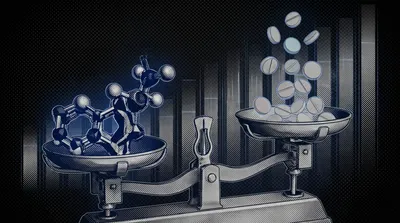
Blaise is designed to pressure-test molecules using the logic a medicinal chemist would apply if they had infinite time and perfect recall. It surfaces likely failure modes early and forces trade-offs into the open. Crucially, it ties those objections back to data, not vibes, making the word “no” defensible rather than political.
This matters because most wasted time in drug discovery comes from molecules that should have been killed earlier, but weren’t—simply because the case against them was fuzzy.
Blaise is not there to out-imagine chemists. It is there to help them do the thing that actually moves programmes forward: killing weak ideas quickly, cleanly, and for the right reasons.
Generative models expand chemical space. Blaise constrains it.
That constraint is not a limitation. It is the work.
If most molecules must die, then the tools that matter are not the ones that create more of them, but the ones that help you decide—with clarity—which ones deserve to live.